
Typically, an injection mold shipped from China spends several weeks at sea. This project took a different path. Technical sign-offs with the toolmaker ran longer than anticipated, leaving the client with an uncompromising priority: time-to-market outweighed freight costs. The two new molds were airfreighted straight to our facility.
Below, we walk through the journey from the shipping crate to the first approved part—and why this stands as one of the most critical stages in the entire project.
Tool Uncrating: Protective Wrapping and Anti-Corrosion Coating Removal
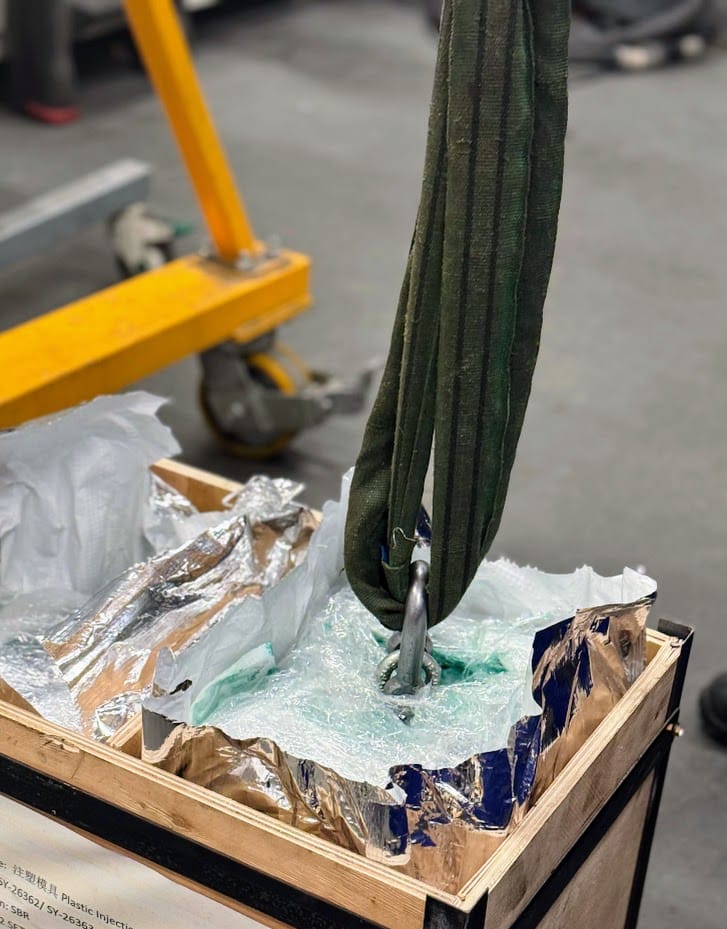
Opening the crates reveals a sight familiar to anyone who has ever taken delivery of tooling from Asia: tight vacuum-sealed foil, followed by a heavy coat of green preservative wax that Chinese toolmakers apply with generous abandon.
And with good reason. Intercontinental transit subjects tooling to condensation and severe thermal cycling; thoroughly degreasing surplus protective compound is vastly preferable to remediating surface oxidation on high-precision cavity faces.
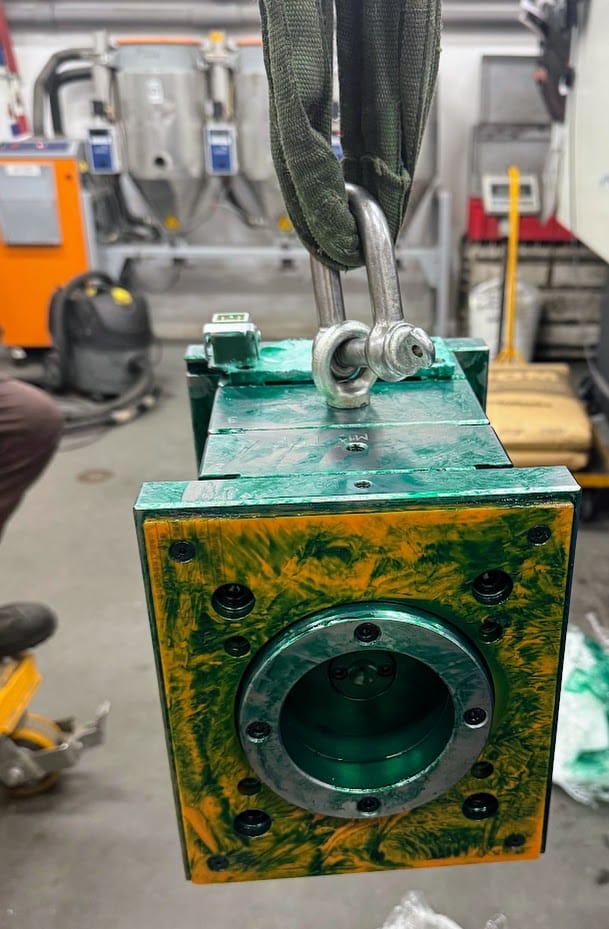
Verification: Ensuring the Mold Matches the Design
This is a behind-the-scenes step that outsiders rarely see, yet the success of the entire project hinges on it. Before the mold is ever mounted on an injection press, we thoroughly verify its compliance against engineering documentation and specifications aligned with both the client and the toolmaker:
- Cavity dimensions and machining quality,
- Inserts and moving components,
- Cooling system,
- Utility connections and physical compatibility with our machines.
Everything that lived solely in drawings and email threads over the past weeks now has to match perfectly in the steel.
First Machine Trials: The Results
By the very next day, both molds were up and running on the injection machine. Here are the first-run results:
- ✅ Part dimensions within specification,
- ✅ Material: POM (polyacetal),
- ✅ Cycle time 5% below target.
That last point impacts the client’s bottom line directly. A shorter cycle time lowers the unit cost of every single part across the entire production lifecycle—often compounding savings over many years.
Offshore Tooling, Local Production in Poland: Where Is the Real Value Created?
We often hear the question: why does a company so committed to manufacturing in Poland source its injection molds from China? The answer is far simpler than it might seem.
We partner with both Polish and Chinese toolmakers. The decision always rests with the client, and we provide transparent guidance either way—evaluating part geometry, capital expenditure, and delivery milestones to find the best fit.
For many small and medium-sized enterprises, the upfront cost of the mold is the primary barrier to entry for automated production. If that capital expenditure is too steep, businesses are left with only two bad options: stick to higher-cost fabrication methods and lose ground to competitors, or offshore the finished product entirely to Asia. Choose the second path, and local manufacturing disappears completely.
When we help a client source more cost-effective tooling, the only thing coming from abroad is solely the tool itselfInjection molding, assembly, and quality control take place right here in Poland throughout the entire lifecycle of the product. That means jobs for our people, purchase orders for local suppliers, and taxes paid here at home.
This allows Polish companies to compete head-to-head on price with imported finished goods, rather than conceding market share. We see this as a practical, proven way to bring manufacturing back home rather than letting it bleed offshore.
How We Manage Injection Mold Projects
We are a family-owned business operating since 1984. We deliver end-to-end project management across every stage:
- Technical Consulting for part design and mold construction.
- Tool shop selection in Poland or abroad, acting as the client’s representative throughout the entire procurement process.
- Supervision and commissioning of the mold, verifying full compliance with technical specifications.
- Mold trials and process optimization on our in-house injection molding machines.
- Serial production, along with pad printing/labeling, assembly, and kitting as required.
See also our Case StudyWe break down how we engineered and launched a component for a client, and the concrete business value it generated for their company.
Developing a new plastic injection molded part?
Tell us about your project. We’ll help you determine the optimal mold concept and tool shop for your budget and timeline.